Day2-DevOps-challange
Traditional IT vs DevOps?
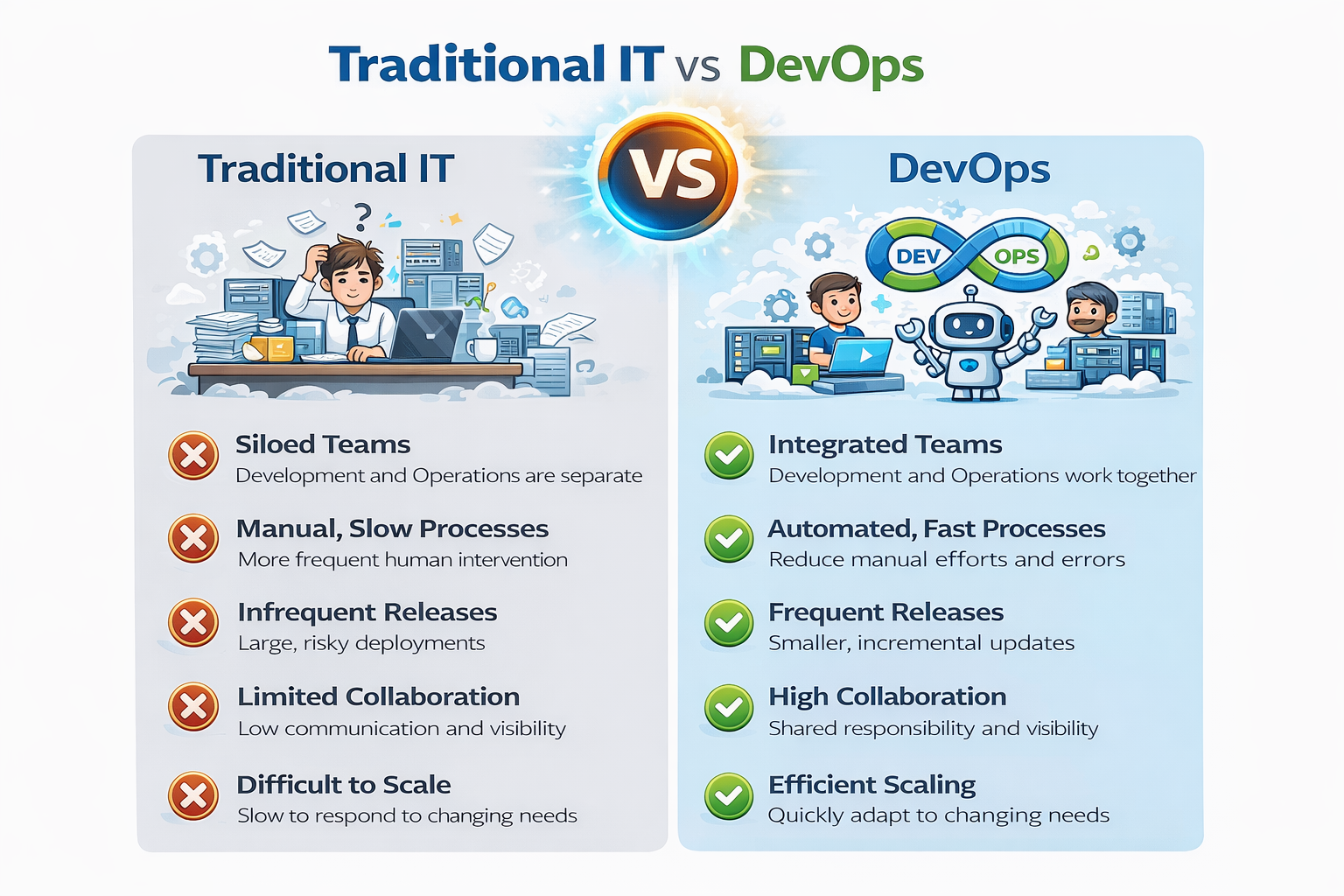
Traditional IT and DevOps are two different approaches to software development and delivery. Traditional IT follows old methods where teams work separately, while DevOps focuses on collaboration, automation, and faster delivery. Understanding the difference between them helps us know why DevOps is widely used today.
Traditional IT Approach
In the Traditional IT model, development and operations teams work independently. Developers write the code and then hand it over to the operations team for deployment. Communication between teams is limited, and responsibilities are clearly divided. This process usually follows models like Waterfall, where each phase is completed one by one.
Because of this separation, software delivery becomes slow. If a problem occurs in production, developers and operations teams often blame each other. Fixing issues takes a lot of time, and system failures are common. Manual work is high, and automation is very limited.
DevOps Approach
DevOps is a modern approach where development and operations teams work together as one team. The main goal of DevOps is to deliver software faster, better, and more reliably. DevOps uses automation tools and continuous processes such as Continuous Integration and Continuous Deployment (CI/CD).
In DevOps, code is automatically tested, built, and deployed. Monitoring tools constantly check system health, and issues are fixed quickly. DevOps encourages continuous improvement and shared responsibility among team members.
Speed of Delivery
Traditional IT delivers software slowly because of manual processes and long release cycles. Releases may take weeks or months.
DevOps delivers software quickly using automation. Updates can be released daily or even multiple times a day.
Collaboration and Communication
Traditional IT has poor communication between teams. Each team works in isolation.
DevOps promotes strong collaboration. Teams communicate regularly and work together to solve problems.
Automation and Tools
Traditional IT relies heavily on manual work, which increases errors.
DevOps uses automation tools like Git, Docker, Jenkins, Kubernetes, and monitoring tools to reduce human errors and save time.
Reliability and Stability
In Traditional IT, failures are common and recovery takes time.
In DevOps, continuous monitoring and quick fixes improve system stability and reliability.
Conclusion
Traditional IT is slow, manual, and less flexible, while DevOps is fast, automated, and collaborative. DevOps helps organizations deliver high-quality software efficiently. That is why DevOps is preferred over Traditional IT in modern software development